Pages

Showing posts with label chemical elements. Show all posts

Tuesday, July 10, 2012

The Revised Periodic Table of Chemical Elements and New Insights About the History of Alternative Models

This is an update to my recent postings (Einstein's Voice, LawPundit) and my website page as originally posted in the year 2000 at LexiLine -- see the Wayback Machine at the Internet Archive.

A reader has alerted me to the fact that Charles Janet came up with the same so-called "left-step" periodic arrangement of chemical elements that I found in 1972 already in the year 1928 . Indeed, there is a recent article referenced at the Wikipedia article on Janet referencing "Stewart, Philip (April 2010). "Charles Janet: unrecognized genius of the Periodic System". Foundations of Chemistry 12: 5–15. DOI:10.1007/s10698-008-9062-5".

As written at the Wikipedia:
"In 1927 [Janet] turned his attention to the periodic table and wrote a series of six articles in French, which were privately printed and never widely circulated."
Even a French biography of him online currently does not have the table as far as I can tell. Biographie synthétique de Charles Janet. I do not speak French to this day so even if I had done any kind of deep research back in those days in 1972, prior to the Internet, the likelihood I would have found Janet's work in the USA is small.

Indeed, back in 1972 I would not have imagined that someone had come up with the same arrangement as I had found and thus I really had no reason to look for previous discoverers since I would have assumed that if someone had had the same idea, it would be well known. I myself sent off a letter to the Scientific American about my "discovery" of the revised periodic table but they paid no attention to it.

Accordingly, as it was just a hobby anyway, I went on with my life and only put up my discovery on the Internet at LexiLine in 2000 when I started my first website online, and when, to my knowledge, there was nothing at all online about alternative models of the Periodic Table, as far as I know. Amazingly, no one, prior to today, has ever paid any attention to my revised period table or commented about it.

That attitude in science epitomizes one of the reasons that I left the study of Biology, Physics and Chemistry in high school and college, by the way, and went on to law and legal studies, leaving the sciences as a hobby.

I was good in the sciences in pre-college studies, already earning college credits in Chemistry in high school, for example, and was sent off as a young student to a science fair where they presented an electron microscope that showed we had 46 chromosomes instead of 48. I dutifully reported on that development in class upon returning to school, whereupon the teacher said to the class immediately afterward that this information was fine but that 48 would be the correct answer for the final exam in that class and for any other test purposes until it was changed in her Biology textbook. That is a true story. That was it for me for Biology. Who wanted to live in the past?

My experience in Physics in high school was much the same. I came up with an algorithm for a complicated class assignment involving the calculation of total resistance in a circuit and my solution was correct, taking half the paper that the accepted method required. Rather than the teacher showing interest in the algorithm, the teacher tried to ridicule the solution in class, unsuccessfully, as I defended the clear logic of it, but that was it for me for Physics. Too much inertia.

And then I had an excessively long hours-long Chemistry lab early on Saturday mornings -- not in my circadian rhythm at all -- where the emphasis was on writing nice-looking lab reports and playing with moles and valences and the like rather than on examining the basic theoretical questions that were of interest to me. That was it for Chemistry. Too many vials.

So the study of law (jurisprudence) it was, where the emphasis was on the reasoning behind the laws and on problem solutions, rather than on repetition of what people already knew (excepted here in law are bar exams and similar, which primarily test knowledge memorized through law review courses and not through Socratic law study, and it is mostly knowledge that any idiot can look up and seldom needs in law practice). But to return to the periodic table ....

I am in fact quite pleased to find that someone in fact came up with the same periodic table arrangement as I did, because it does seem to me to be quite logical "in the broad view" to view the chemical elements this way.

Hence, it is gratifying to see "like minds" out there and I will definitely be doing some study of Charles Janet in the future, although it is clear from his alternative tables that he did not really understand what he had found.

The reader -- already cited above -- writes that a certain L.M. Simmons had the same arrangement idea in 1947 (A modification of the periodic table, but that publication even today is not accessible to me online because I am not an ACS member -- that's science! ... sadly). That same reader also notes that Edward Mazurs "publicized" the "left-step arrangement" in 1957, but in fact it was a "private printing" titled Types of Graphic Representation of the Periodic System of Chemical Elements, to which I could not possibly have had access. A revised accessible edition was first published in 1974 as Graphic Representations of the Periodic System During One Hundred Years.

I find online now that there is even a detailed article at the Wikipedia on Alternative periodic tables. See also Periodic Tables by David V. Black. where Black notes that Mazurs collected all sorts of alternative periodic tables and -- to my great astonishment -- was a fellow Latvian as a Professor at the University of Riga. As Black writes, and this is the important thing:
"Mazurs came to the conclusion – and so have I – that a left-step table works best....".
I am not now going to research all the myriad other alternative tables presented in the interim, but wish to point out that apparently none of these previous researchers realized the significance of the "left-step" revised periodic arrangement in showing how the underlying principle is gravitational for the elements as a whole, rather than viewing each element individually or in some "category", as chemists are wont to do, based on their "properties". I was not interested in chemical properties. I was interested in the underlying principle of physics that governed chemical element formation. All periodic tables -- even if useful -- that depart from the underlying gravitational principle are in my opinion not fully accurate.

A most recent article from July 20, 2011 at ChemistryViews.org in At Last A Definitive Periodic Table? (DOI: 10.1002/chemv.201000107) by David Bradley reports essentially that some observers currently still virtually reduce the 1, 4, 9, 16 sequence to mere "numerology", talking about odd numbers and all sorts of irrelevant extraneous things, thus showing that chemists and physicists are still unable to get away from their familiar world of electron shells, rather than trying to find the "basic" force of nature underlying those shells.

In other words, even though there have been predecessors to my own arrangement of the periodic table as far back as the year 1928, scientists still do not "get" what the periodic table revised in this way means.

The principle of chemical element formation is the same as the acceleration of an object in a vacuum, except that we have no "distance" (in the accelerative sense) but rather instead increasing "mass" -- well, that is the same as the idea of the relation between the Higgs Field and mass, and therefore, the Higgs Field is no different than this basic GRAVITATIONAL PRINCIPLE, which the Higgs Boson Theory ignores completely.

Physicists and chemists in explaining the inner workings of the elements do not stick to the gravitational principle but create artificial constructs such as "the weak force" or "the strong force", which in my opinion merely shows that they do not understand how to measure gravity at the atomic and subatomic level.

I.e. the elements in my opinion are created according to the gravitational principle internally, and it is up to Physics and Chemistry down the road to put their concepts of strong and weak forces into that basic gravitational system -- and this also applies to the Higgs Field and the Higgs Boson. If there is a Higgs Field, that Higgs Field is gravity.



Friday, July 06, 2012

Higgs, The Aether, Gravity, The Periodic Table of Chemical Elements Revised, and the Gravitational Principle of the Universe

"Since there is no DISTANCE involved in the building of the elements,
the gravitational effect exerts itself on the mass of the elements.
"
- Andis Kaulins, February 13, 1972

We see this process in the spectral emission lines of hydrogen (Bohr model)
that are in the clear relationship 1, 4, 9 and 16, i.e. 1², 2², 3² and 4²
as below (Wikipedia), representing the electron orbits in the Bohr model,
i.e. "the energy of an electron in any one of these orbits
is inversely proportional to the square of the integer n."):


 ....1²....2²........... 3²............................................. 4².........

I wrote the first line found now at the top of this page 40 years ago when I came up with a suggested revision of the Periodic Table of Chemical Elements (shown below), a revision based on the hypothesis that what the spectral lines of hydrogen showed was applicable to ALL elements taken to together, as the basic gravitational principle of their construction. That Table has been online at LexiLine for many years and no one has paid any attention to it.

[please read this page first and then see the update to this page on previous similar alternative tables - I am not the first to find the "left-step" model]

In the aftermath of the alleged Higgs Boson discovery, I drew a new illustration as below, and the original revised chart you will find further below that in this posting:


The gravitational principle is similar to the alleged Higgs Boson in The Standard Model, with the difference, of course, that as far as The Periodic Table is concerned, electrons are fermions and not bosons, as Jon Butterworth explained last year at The Guardian's Life & Physics in Bosons and Fermions:

"Chemical elements consist of an atomic nucleus surrounded by electrons.
Because electrons are fermions, not all the electrons can be sucked into
the lowest energy level around the nucleus.... So as more electrons are added around a nucleus, they have to sit in higher and higher energy levels - less and less tightly bound to  the nucleus, in general. The behaviour of a chemical element - how it reacts with other elements and binds to form molecules, and where it sits in the periodic table - is driven by how tightly bound its outermost electrons really are." [emphasis added]


We regard that binding force to be gravity -- on a subatomic scale, regardless of how one labels it. Indeed, internal GRAVITATION was the basis of our suggested revision of the Periodic Table of Chemical Elements, 40 years ago:

THE PERIODIC TABLE
OF CHEMICAL ELEMENTS:
A SUGGESTED REVISION

Originally Discovered February 13, 1972 by Andis Kaulins

The Periodic Table of Chemical Elements used in mainstream science
is more than 100 years old and severely outdated.
It is retained because mainstream chemistry is used to it.
It does not correctly represent nature.

Below is the standard mainstream version from 1972
showing "God's footnotes" (typical for the academics)
the actinides and lanthanides.
For the current status of the periodic table see
Webelements.com - Period Table of Chemical Elements

Mainstream Periodic Table 1972


The above table is disorderly and requires
"God's footnotes"
for the actinides and lanthanides.
Nature can not possibly work this way.
The simplicity has been camouflaged
and replaced with unnecessary complexities.

Dmitri Mendeleev
originally made the above table using the chemical elements then known
by arranging cards on his living room floor.

In his era, it was a great step forward.
Today, it is a Model-T Ford,
but people are used to using it,
and have retained it for that reason.
Convenience is a higher priority than correctness.

A "correct" table of the elements
would show the general laws of nature immediately.
It is in fact possible to construct such a corrected table,
showing the gravitational law at the root of all of matter,
for this process extends in both directions!

The Kaulins Revised Periodic Table of the Chemical Elements


The above graphic stems from the year 1972.

Since then more elements have been discovered, all fitting into this scheme.
For the current status see
Webelements.comPeriod Table of Chemical Elements

The principle at the root of the periodic table of elements is gravity.


The elements are formed by internal gravity,
as in the spectral lines of Hydrogen,
where the intervals are 1, 4, 9, 16
-- those are --
the numbers 1, 2, 3, and 4 squared
i.e. 1², 2², 3² and 4².

The 4 elements from H to Be
build one entity of 4
so that 4 divided by 4 = 1 = 1².

The 16 elements from B to Ca build the next entity of 16
so that 16/4 = 4 = 2².

The elements from Sc to Ba
build the next entity of 36
so that 36/4 = 9 = 3².

The elements from La to No. 120
build the next entity of 64
so that 64/4 = 16 = 4².

What we see in the spectral lines of hydrogen
thus applies to all the chemical elements viewed as a whole
and subsequently also the structure of the universe generally.
The electron rings show how matter in the universe distributes itself.

The process of element-building is comparable
to a mass which falls under the influence of gravity as follows:


The above chart is Galileo and Newton revisited,
but at the atomic level, it accords with Einstein's E=mc2 energy analysis,
which is calculated -- as explained by physicist Dr. William Watson, DEO,
U.S. Department of Energy Office of Scientific and Technical Information --
in Celebrating Einstein: E=mc2 - What's the Speed of Light Got to Do With It?
"Since the velocity of the object as seen by the moving observer,
"v", is the same after it emits the energy as it was before,
the only way its kinetic energy can change is if its mass changes.
Evidently, the mass changes by L/c2 -- by the energy the object emits (in our frame of reference), divided by the speed of light in a vacuum squared. Since, as Einstein pointed out, the fact that the energy taken from the object turns into light doesn't seem to make any difference, he concluded that whenever an object emits an amount of energy L of any type, its mass diminishes by L/c2, so that the mass of an object is a measure of how much energy it contains ."
__________

Update, 40 years later....July 4, 2012....in the days of the Higgs Boson....

The basic logic of my illustrations above corresponds to the more modernly called "Higgs Field", a theoretical construct which corresponds in its root conception to what the Ancient Greeks called the "aether".

Forty years ago I thought that the aether of the Greeks was -- and I also think now that the posited Higgs Field is -- nothing other than our familiar (but unexplained) all-pervasive gravity viz. gravitation, which governs the motion and interaction of all bodies (collections of "mass") in space. Indeed, gravitation "accelerates all objects at the same rate" if there is no resistance.

In the metaphysical sense we might view such physical bodies as "something" and the corresponding space as "nothing" in which "somethings" are found.

Space for physicists is often defined in terms of "extension" -- similar and with no more accuracy than Lewis Carroll's definition of his term "WABE" (quoted from Through the Looking Glass):
'And "THE WABE" is the grass-plot round a sun-dial, I suppose?' said
Alice, surprised at her own ingenuity.
'Of course it is. It's called "WABE," you know, because it goes a long
way before it, and a long way behind it—'
'And a long way beyond it on each side,' Alice added.
'Exactly so.'
Bodies in space are neither particles nor waves per se and that is why Physics speaks modernly of a matter wave, combining the two concepts. A unified concept like matter wave is necessary because the terms "particle" (viz. "matter") and "wave" merely describe what we are able to observe (i.e. particles, and the way particles move) --  but not both at the same time -- something called the uncertainty principle in physics.

Einstein used the example of a moving locomotive. Where is that locomotive at any given time when moving, and do we look to the front, back or middle of the locomotive when we make our measurements?

At the subatomic level, physicists face this problem all the time -- everything is motion, and maybe what their experimental results show is in fact either the front or the back or the middle of any given body, or wave of motion - like the differing poles of a magnet -  which may account for things like electromagnetism and the weak interaction being viewed as two different things, whereas in fact they are the same as the electroweak reaction.

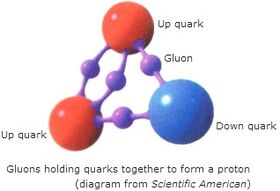
Indeed, perhaps the "three color flavors" of quarks are nothing more than measurements of one or more identical quarks in different positions as a "particle" viz. "wave" located at different parts of the locomotive, so to speak, top, front, back, bottom, sides, etc. We suspect as much, since no single quark or equally elusive companion gluon has ever been isolated, allegedly because they are glued together too strongly. -- Or because the theoretical model is flawed. -- The physicists see the flavored and colored quarks like this (two "up" quarks (U) and one "down" quark (D) -- surely one of the most forced, and surely erroneous, theoretical explanations of nature you will ever see:


The Scientific American had the following image including the gluons, via the Química wiki:


What is important to emphasize time and again is that all of these are merely purely theoretical constructions that aid scientists to explain how things work.

Human theories of matter and space in Physics must also be able to account for things like light (electromagnetic radiation) or energy, which are fundamental "relations" in a cosmic world that has no singularities, i.e. no objects that are fully independent of other objects in the universe.

Everything is interconnected.

Physical "bodies" in the larger sense are not only things like suns, planets or distant galaxies, but also include the chemical elements, which
-- in our view --
provide us with essential information about how the universe works, for the rules that operate here will be the same as operate throughout the universe, only on a smaller scale.

Sky Earth Native America

Sky Earth Native America 1 :
American Indian Rock Art Petroglyphs Pictographs
Cave Paintings Earthworks & Mounds as Land Survey & Astronomy
,
Volume 1, Edition 2, 266 pages, by Andis Kaulins.

  • Sky Earth Native America 2 :
    American Indian Rock Art Petroglyphs Pictographs
    Cave Paintings Earthworks & Mounds as Land Survey & Astronomy
    ,
    Volume 2, Edition 2, 262 pages, by Andis Kaulins.

  • Both volumes have the same cover except for the labels "Volume 1" viz. "Volume 2".
    The image on the cover was created using public domain space photos of Earth from NASA.

    -----

    Both book volumes contain the following basic book description:
    "Alice Cunningham Fletcher observed in her 1902 publication in the American Anthropologist
    that there is ample evidence that some ancient cultures in Native America,
    e.g. the Pawnee in Nebraska,
    geographically located their villages according to patterns seen in stars of the heavens.
    See Alice C. Fletcher, Star Cult Among the Pawnee--A Preliminary Report,
    American Anthropologist, 4, 730-736, 1902.
    Ralph N. Buckstaff wrote:
    "These Indians recognized the constellations as we do, also the important stars,
    drawing them according to their magnitude.
    The groups were placed with a great deal of thought and care and show long study.
    ... They were keen observers....
    The Pawnee Indians must have had a knowledge of astronomy
    comparable to that of the early white men."
    See Ralph N. Buckstaff, Stars and Constellations of a Pawnee Sky Map,
    American Anthropologist, Vol. 29, Nr. 2, April-June 1927, pp. 279-285, 1927.
    In our book, we take these observations one level further
    and show that megalithic sites and petroglyphic rock carving
    and pictographic rock art in Native America,
    together with mounds and earthworks, were made to represent territorial geographic landmarks
    placed according to the stars of the sky using the ready map of the starry sky
    in the hermetic tradition, "as above, so below".
    That mirror image of the heavens on terrestrial land is the "Sky Earth" of Native America,
    whose "rock stars" are the real stars of the heavens,
    "immortalized" by rock art petroglyphs, pictographs,
    cave paintings, earthworks and mounds of various kinds (stone, earth, shells) on our Earth.
    These landmarks were placed systematically
    in North America, Central America (Meso-America) and South America
    and can to a large degree be reconstructed as the Sky Earth of Native America."

    Most Popular Posts of All Time